
Texas Busted Mugshots: Public Access
Sometimes yes, sometimes no. Texas has no single rule requiring booking photos online. The Public Information Act, Government Code Chapter 552, lets anyone request existing public information from a government body, photos included, subject to exceptions. It governs records a custodian already holds. It does not force a sheriff or jail to put photos on a roster. A copied entry found in a search never replaces the agency's own record.
Chapter 109 answers a different question. It covers certain businesses publishing criminal-record information under source and fee conditions, not every publisher. It is not a statewide ban. An arrest photo may simply be absent from a roster. Use the statewide county lookup hub to reach official local sources.
Check the court's later disposition. That is the final outcome in a case. A booking entry alone is never the whole story.
Texas Busted Mugshots and Chapter 109
Chapter 109 defines criminal-record information broadly. It sweeps in arrest details, charges, dispositions, and identifying data. It also covers any photograph taken in connection with an arrest or other criminal-justice involvement. Publication, under the statute, covers writing and electronic communication alike. So a booking photo falls within its subject matter. The duties still attach only in a narrower case. The publisher and the record must fit the statute's test. The current Chapter 109 text lays out both the definitions and that test.
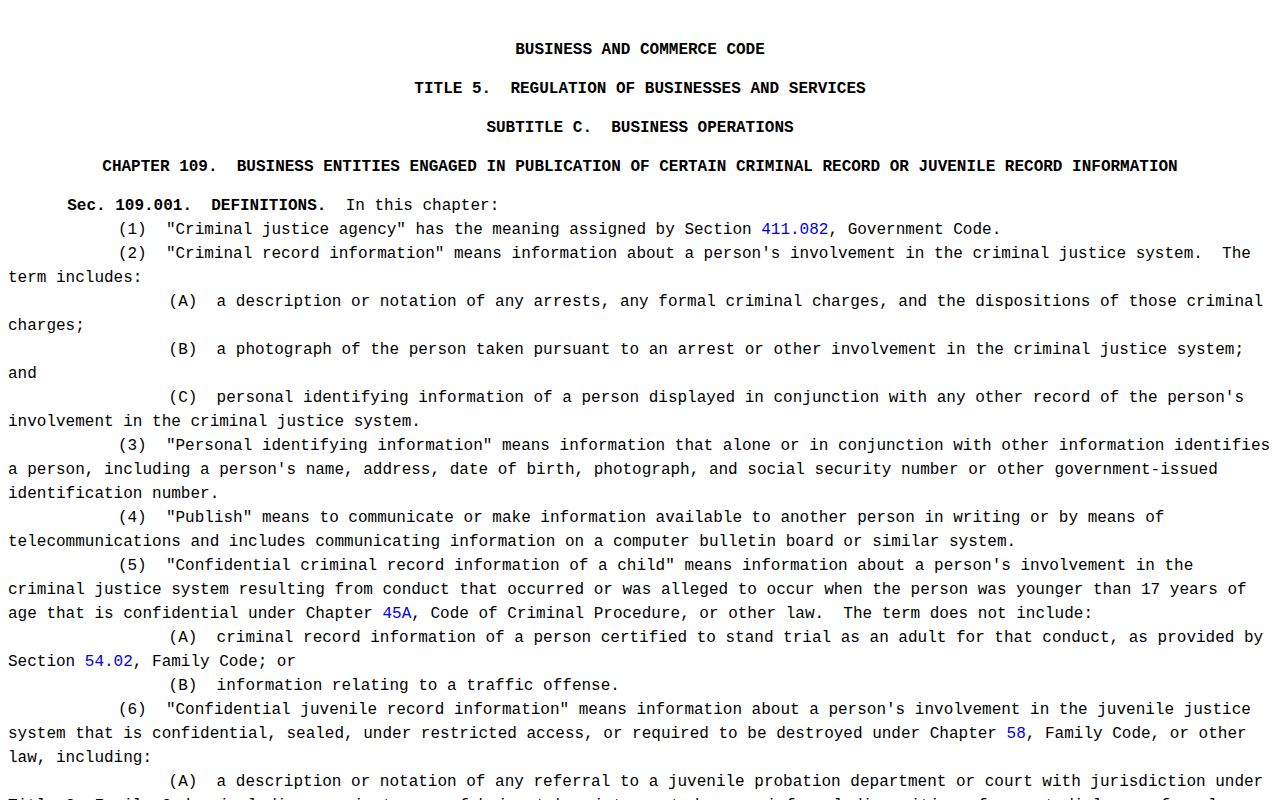
The statute treats arrest photos as records. That does not make every photo public, though. Nor does it put every publisher under the same duties.
The main rule in §109.002 uses a narrow source-and-fee test. It reaches a business entity publishing information first obtained through a Public Information Act request. Department of Public Safety records are another qualifying source. The publisher must charge at least $150 to remove the information. A fee of comparable value counts as well. Charging any fee to correct or change the material counts too. A separate rule covers confidential juvenile or child records published in violation of law. No source or fee test is needed. Exemptions include the statewide juvenile information system and general-circulation news publications. FCC-licensed radio and television stations are exempt too. Certain information or interactive computer services are also exempt. Telecommunications providers round out the list. Each publisher's status depends on its own facts.
Senate Bill 1289 created Chapter 109 in 2013, effective September 1. In 2023, House Bill 3825 proposed a broader conviction-centered rule. It was postponed and never became law. Both bills are history, not today's access rule. See the SB 1289 record and the HB 3825 history. A county's choice not to post a photo does not make it secret. And a third-party copy never forces an agency to release its record.
Note: Chapter 109 reaches only publishers meeting its definitions, source rules, and fee conditions, so coverage is fact-specific.
Correcting a Texas Busted Mugshot Record
A publisher covered by §109.002 must keep its posted record complete and accurate. Complete means it includes the arrest, the filing of charges, and the disposition. Accuracy is judged against the latest DPS information. Data the publisher obtained from the agency within the prior 60 days also works. A booking page that never adds a later dismissal or acquittal can mislead. The first entry may have matched the arrest record.
Section 109.004 requires a clear email, fax, or mailing address. The person named in the record can use it to dispute accuracy or completeness. The publisher must verify the information with its source agency at no charge. It must investigate within 45 business days. If it finds an error or omission, it must promptly remove or correct the item. A written result must go out after the investigation ends. The deadline is five business days. It may not charge to fix an incomplete or inaccurate record.
Sections 109.005 and 109.006 create civil remedies. A person named in prohibited information may seek up to $500 for each violation and continuing day. They can also seek an injunction, costs, and attorney fees. That applies if they prevail. The attorney general or an appropriate prosecutor can also act. That official may seek a state penalty of up to $500 per violation. The penalty can accrue each continuing day. These remedies punish statutory violations. They do not apply to every demand to delete an accurate entry.
Use the publisher's stated correction route. Keep a copy of what was sent. Identify the exact page, the name, and the arrest details shown. State the error and include the record proving the correct information. Updating a disposition is one thing. Erasing an accurate, current public entry is another.
Texas PIA Requests for Booking Photos
Texas keeps no single statewide booking-photo repository. Each Public Information Act request goes to the office holding the record. That could be the arresting police department. It could also be a sheriff, a county jail, or another booking agency. Each may hold a different slice of the file. Name the likely custodian rather than asking one office to sweep every county. The Act opens existing records. It never forces an agency to build a statewide list or answer questions in place of producing documents.
Put the request in writing to the agency's public-information officer. Be specific. For one booking, give the person's name. Add an arrest or booking date, or a range. Add a case number if you have one. Name every item you want. That might mean the booking photo or booking sheet. It could include the arrest report, charge record, or a release and disposition notation. Ask for an electronic copy when available. The Public Information Act and the Attorney General's request instructions walk through the agency route.
Some material can be withheld under §552.108. An agency will point to possible interference with an investigation or prosecution. Even then, Section 552.108(c) keeps basic facts open. That covers the arrested person's basic information, the arrest, and the crime. Privacy rules can shield other parts. So can confidential sources, medical material, juvenile files, and family-violence statutes. Its written response should name the exception claimed. The phrase "booking photo" alone does not settle whether release follows.
- Send the request to the agency most likely to hold the booking or arrest record.
- Describe the existing photo and related records, with enough details to find the event.
- Review the response for released fields, redactions, or the stated legal exception.
- If the agency says another office holds the record, send a focused request to that custodian.
A roster shows custody status only. Compare that entry with the court case. Do that before drawing conclusions about where a record sits. The arrest file stays with its agency even after a release.
Note: A Public Information Act response covers only the records that office holds; it never creates one statewide photo archive.
Expunction and Nondisclosure in Texas
Expunction and nondisclosure are two different fixes. An expunction is a court order directing that eligible arrest records be destroyed or returned. Nondisclosure instead seals qualifying information from ordinary public view. Expunction follows a recodification. Texas Code of Criminal Procedure Chapter 55A governs it now, effective January 1, 2025. The route depends on the case. Grounds include acquittal, no charge, dismissal, an expired limitations period, a pardon, or another statutory basis. Common waiting periods run 180 days for a Class C arrest. Class A or B misdemeanors carry one year. A felony arrest carries three years. Related charges, conditions, and a possible prosecutor waiver all matter. These are eligibility periods only. They are not dates when a record vanishes on its own.
Once the order is final, Chapter 55A directs the clerk. The clerk sends it to DPS, the Office of Court Administration, and every government entity named in the order. Agencies must generally destroy or return the covered records, subject to listed exceptions. Check the current Chapter 55A text and get advice for your case. Then send the order with exact record details to the custodian. Send it to any publisher still showing the photo. An arrest without a conviction, by itself, is not enough.
Nondisclosure hides the record from the public. It stays visible to law enforcement and other authorized agencies. Deferred adjudication means the court defers a final finding while the person completes set conditions. Wait times vary. The Texas Judicial Branch lists some misdemeanors with no wait after discharge and dismissal. Other listed misdemeanors carry a two-year wait before eligibility opens. A qualifying felony can carry five years. Fees and completed terms still control. The Judicial Branch forms explain each route and its requirements. They also cover exclusions tied to the case outcome.
Chapter 109 §109.005 gives one more lever. A covered publisher may know about the order. It may instead receive formal notice. Once either happens, publishing the record is barred. Send the order to the agency and to each covered publisher holding a copy. Include the exact page address and the name used in the entry. Add the arrest date and the county. Tie the request plainly to the order. Keep your sent notice and any reply. Neither remedy guarantees that every copied image vanishes from every corner of the internet.
Juvenile and Withheld Texas Records
Juvenile records follow a different rule in Texas. Confidentiality is the baseline under Family Code Chapter 58. Access is limited to the groups and uses the law allows. A juvenile case file can hold photos and arrest details. That never makes it an adult booking source. Confirm age and record status with the court or agency. Do not trust an image or a name alone.
Chapter 109 adds a publisher-level safeguard. Section 109.0045 bars covered businesses from publishing confidential juvenile or child criminal-record information. Written notice triggers removal. The material must come down immediately unless a statutory exception applies. Republishing then requires confirmation. The record must be no longer confidential, or disclosure must be allowed. Read the official Family Code Chapter 58 alongside Chapter 109. A third-party page is not proof that a juvenile record may lawfully be reposted.
Texas Busted Mugshot Opt-Out Paths
Start with the agency that holds the record. Its published process is the right channel for an inaccurate entry or one covered by an order. Ask the office to confirm the record's status. It can correct the entry where the law allows. Then send each publisher the order or proof of the factual error. A corrected government record does not reach them automatically. Other sites keep their own copies, which can go stale or omit a court outcome.
Third-party pages are unofficial. The RecentlyBooked Texas county index is one secondary route. Its page says coverage covers only the preceding 30 days and varies by county. The site displays a county index rather than a government roster or official statewide feed.
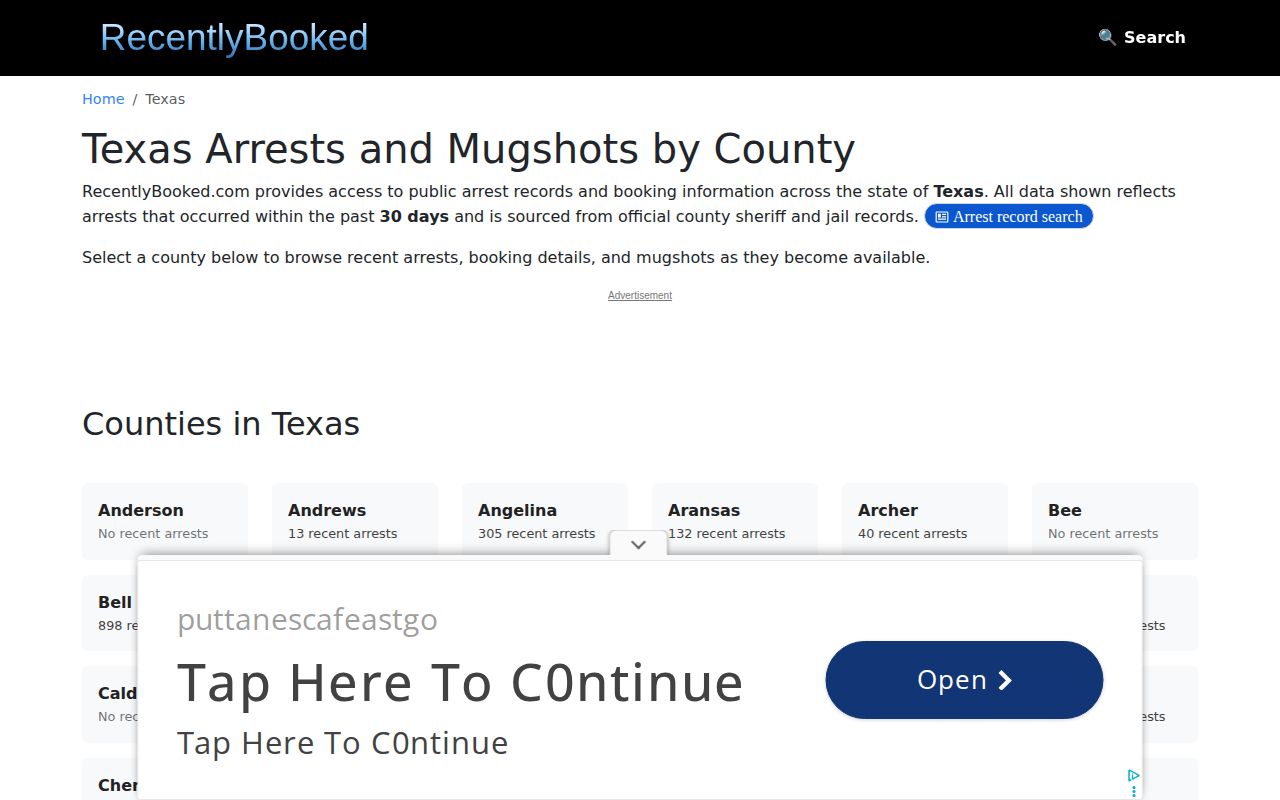
RecentlyBooked also posts a separate published correction policy. Requests are free, and the listed grounds include dismissal, expunction or sealing, outdated details, mistaken identity, juvenile material, and duplicate records. It asks for the page address, name, arrest date, county, reason, and supporting court papers where relevant. An accurate, current public record may not qualify. Approval is never assured. The Mugshots.com Texas index is another secondary archive. It is not an agency. Its state page sorts records by location and displays a search interface rather than an official custody system.
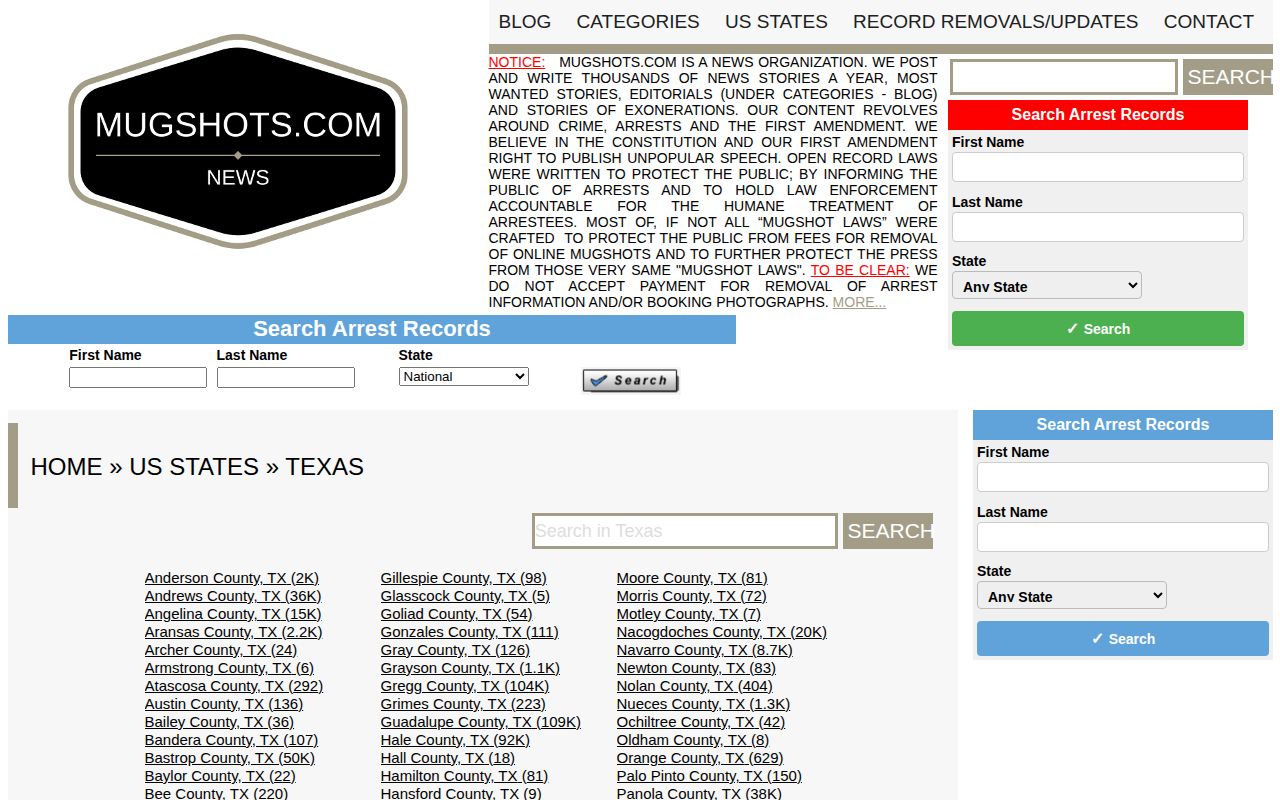
On its record-maintenance page, Mugshots.com describes a free update or removal request when qualifying papers are supplied, including certain court orders. A separate route exists for a favorable disposition. Busted Newspaper offers a free listing-correction route too. It covers specified outcomes and asks for the exact page plus supporting details. The publisher gives a five-to-ten-day handling estimate. These routes promise nothing. Never pay anyone who guarantees a result. Check the current process, and keep a copy of the request.
Note: Publisher terms can change, so confirm the current route before submitting and keep a copy of each request you send.
Search Refresh After Source Correction
Fix the source page first. Only after an agency or publisher corrects or removes the original does a search-engine refresh make sense. A stale result or cached snippet can then go through the engine's outdated-content process. Google's Refresh Outdated Content tool targets the search listing itself. It touches nothing else. The sheriff's record, court file, news story, and archive entry all stay put. The route opens with a Google sign-in screen. Keep proof of the source correction. Submit the stale result and check later whether the listing changed. A refreshed result can still lead to a live source page.
A refreshed search result is not an expunction order. It leaves the court's disposition untouched, so keep the agency record, the correction response, and the search request as three separate items.